
Support for Surprise, AZ
Technical Brief Supporting Resident Pushback in Surprise

Project Baccara: Public Air Quality Impact Assessment
Sensitive Receptor Analysis & Citizen Comment Guide
Prepared for West Valley Residents | Maricopa County MCAQD Review Process | May 2026
Purpose of This Brief
This document is intended to help Waddell and West Valley residents understand the specific air quality risks posed by Project Baccara, a proposed 744 MW natural gas power plant and data center complex, and to equip them with technically grounded, factually accurate content for public comment submissions to the Maricopa County Air Quality Department (MCAQD). Nothing in this brief constitutes legal or regulatory advice.
I. Project Overview
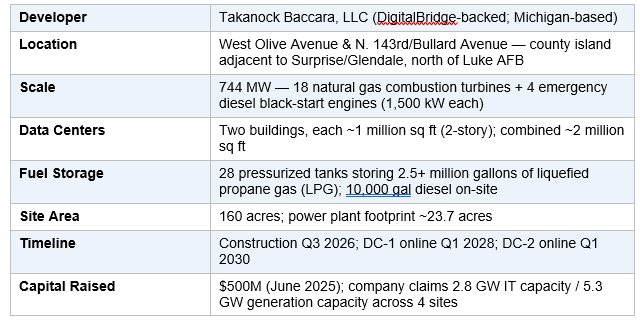
Permitting Status as of May 2026
Arizona Corporation Commission (ACC): CEC approved 5-0 on February 4, 2026. The ACC approved the Certificate of Environmental Compatibility for the 700 MW natural gas plant, citing its heavy-industrial zoning and self-contained power supply as key rationale.
Maricopa County P&Z Commission: Military Compatibility Special Use Permit approved unanimously on April 9, 2026, despite 225+ written opposition letters submitted.
Maricopa County Board of Supervisors: Scheduled to consider final permits on or around May 6, 2026.
MCAQD Air Quality Permit (Rule 220): ACTIVE, this is the critical remaining gate. The Draft Permit and Technical Support Document govern emissions limits, stack testing, monitoring, and operational constraints. Public comment on this permit is still open and consequential.
Why the MCAQD Permit Is the Most Important Remaining Action
The CEC and Military Compatibility processes examined land use, grid compatibility, and base interference. Neither process independently evaluated cumulative air quality impacts on nearby schools and residences. The MCAQD Rule 220 permit is the only instrument that legally constrains pollutant emissions. Deficiencies in this permit are the primary risk to community air quality. This is where resident engagement matters most.
II. Regulatory Background: What the Standards Mean
National Ambient Air Quality Standards (NAAQS)
The U.S. EPA establishes National Ambient Air Quality Standards (NAAQS) for six criteria pollutants that are harmful to public health. These standards define the maximum allowable concentration of a pollutant in the outdoor air that the general public breathes. They are health-protective thresholds, not industry targets.
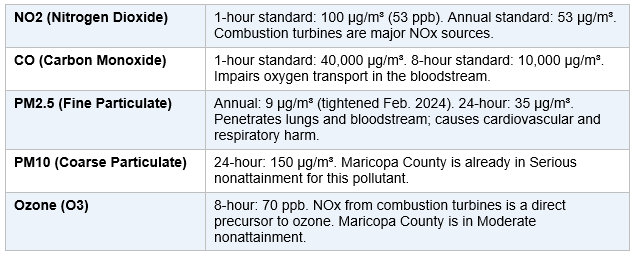
Maricopa County Nonattainment Status
Nonattainment means a region already exceeds federal health limits for a pollutant. Adding new emissions sources in nonattainment areas requires stricter review and offset requirements under the Clean Air Act.
Ozone (8-hour NAAQS): Maricopa County has been in nonattainment for approximately a decade. EPA reclassified the Phoenix-Mesa area from Marginal to Moderate nonattainment in 2022. ADEQ has documented that the county faces potential escalation to Serious nonattainment status, with Severe nonattainment possible by 2027. As of March 2026, the EPA agreed to allow a Section 179B international transport demonstration that may prevent reclassification, but this does not change the underlying measured air quality. Unhealthy ozone levels remain a documented public health reality in the West Valley.
PM10 (Coarse Particulate): Maricopa County is designated as a Serious nonattainment area for PM10. This is the most stringent nonattainment classification short of Extreme.
PM2.5 (Fine Particulate): ADEQ has recommended a partial county nonattainment designation for Maricopa County under the revised 2024 annual PM2.5 NAAQS of 9 µg/m³ (tightened from 12 µg/m³). Final designations are pending federal action.
What Does This Mean in Plain Language
Waddell residents already breathe air that exceeds federal health standards for ozone and coarse particulate matter. The proposed project adds an industrial combustion complex, 18 natural gas turbines operating continuously, to an airshed that already cannot meet basic health thresholds. This context is legally and scientifically material to the MCAQD permit review.
New Source Review (NSR) & the ‘Synthetic Minor’ Mechanism
Under the Clean Air Act, facilities that emit above the defined ‘Major Source’ thresholds must undergo full New Source Review (NSR), which requires the Best Available Control Technology (BACT) and emissions offsets. In nonattainment areas, NSR requires Lowest Achievable Emission Rate (LAER), controls plus emissions offsets that exceed the new emissions being added.
To avoid this enhanced scrutiny, a developer may voluntarily accept permit conditions that hold potential-to-emit (PTE) below Major Source thresholds. This is called ‘Synthetic Minor’ status.
For the Phoenix nonattainment area, the Major Source threshold for ozone precursors (NOx + VOC) is 50 tons per year (tpy) and 100 tpy for CO.
Project Baccara has structured its permit application to stay at approximately 90% of these thresholds, by design. This leaves essentially no compliance headroom.
If actual operational emissions modestly exceed permit conditions due to overloads, equipment variability, or increased operating hours, the facility could breach Major Source thresholds. No independent enforcement mechanism currently guarantees real-time emissions monitoring visible to the public.
III. Sensitive Receptor Analysis
A. Who Are ‘Sensitive Receptors’ and Why Do They Matter?
In air quality regulation, ‘sensitive receptors’ are population groups that face disproportionate health risk from pollutant exposure. The EPA and state agencies recognize the following categories as requiring heightened protection:
Children (under 18): Their developing respiratory and neurological systems are more susceptible to the damaging effects of pollutants. Children inhale more air per unit of body weight than adults. Air pollution effects during childhood can cause permanent lung function deficits that persist into adulthood.
Outdoor workers and students: Sustained physical exertion (recess, PE, sports practice) significantly increases breathing rates and therefore pollutant intake. A student running on a field adjacent to a NOx plume absorbs far more NO2 per hour than a sedentary adult indoors.
Elderly residents and those with pre-existing conditions, such as cardiovascular disease, asthma, and COPD, face acute risk from PM2.5 and ozone exposure.
Federal air quality regulations require that ambient air quality modeling specifically evaluate impacts at identified sensitive receptor locations. Exceedance of Significant Impact Levels (SILs) at those locations is a legally relevant finding in the permit process.
B. The Seven Schools Within Two Miles
Project Baccara’s permit application acknowledges seven schools and learning sites within or proximate to the 2-mile modeling receptor zone. These include:
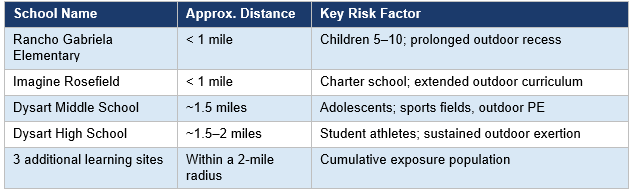
Cumulative exposure population
Each of these schools operates during daytime hours that overlap directly with peak combustion turbine operating periods, when NO2, CO, and PM2.5 concentrations at nearby receptors are highest. Outdoor activities (recess, PE, athletics) create peak inhalation exposure exactly when and where pollution concentrations are elevated.
Key Analytical Gap: No Cumulative Pediatric Exposure Assessment
The developer permit application models ambient concentrations at receptor points, however, the Technical Support Document does not appear to include a cumulative child-specific exposure analysis that accounts for: (1) hours per day children spend outdoors at these schools, (2) higher ventilation rates during physical activity, (3) background concentrations already elevated due to Maricopa County nonattainment status, or (4) the combined PM2.5 from 18 turbines plus 4 diesel black-start engines during startup events. Citizens and the MCAQD should require this analysis.
C. Significant Impact Level (SIL) Exceedances
Significant Impact Levels (SILs) are EPA-defined screening thresholds used in air quality permitting to determine whether a proposed source’s emissions will meaningfully affect ambient concentrations at receptor locations. When a project’s modeled impact EXCEEDS a SIL, it does not automatically mean the project violates NAAQS, but it does mean:
The source is contributing a non-trivial amount of additional pollution to that receptor location.
More detailed cumulative modeling is required before the permit can demonstrate NAAQS compliance.
Combined with pre-existing nonattainment background concentrations, even a ‘below-NAAQS’ increment can push receptor-level exposures into harmful ranges for sensitive populations.
According to the permit application’s own modeling data (Technical Support Document, Tables 1 and 2), Project Baccara exceeds SIL values for the following pollutants at nearby receptor locations:
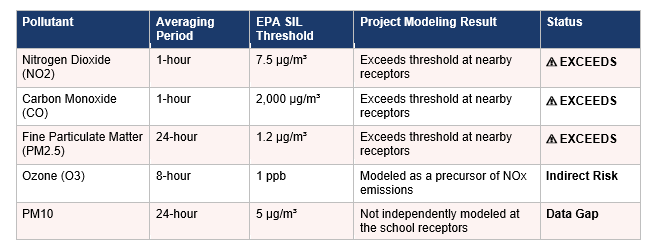
Data Gap
This is technically significant. The developer’s own modeling, performed under optimistic dispersion assumptions, shows these three SIL exceedances. SIL thresholds are de minimis impact markers. Exceeding them at school receptor locations means the project’s emissions are not trivially small relative to health-protective standards.
D. Health Effects of the Three Flagged Pollutants on Children
Nitrogen Dioxide (NO2)
NO2 is produced during high-temperature combustion and is a primary product of natural gas turbine operations. Health effects include:
Airway inflammation and respiratory irritation even at short-term exposures.
Increased frequency and severity of asthma attacks in children with pre-existing asthma.
Impaired lung development in children with chronic exposure is a permanent effect that cannot be recovered after growth phases conclude.
At elevated concentrations, NO2 reacts with sunlight and VOCs to form ground-level ozone, compounding the impacts of exposure. This is particularly relevant given the West Valley’s already-elevated ozone background.
Carbon Monoxide (CO)
CO is a colorless, odorless byproduct of incomplete combustion. While 1-hour SIL exceedances suggest localized peak concentration events, health effects include:
CO binds to hemoglobin with approximately 240x greater affinity than oxygen, reducing blood oxygen-carrying capacity.
In children with cardiovascular or respiratory conditions, even moderate CO exposure can cause headaches, dizziness, and cardiovascular stress.
Peak hourly CO releases from turbine startup events, particularly from the 4 diesel black-start engines, can produce localized concentration spikes that are not adequately captured by annual-average modeling.
Fine Particulate Matter (PM2.5)
PM2.5 is the most systemically dangerous pollutant emitted by combustion facilities at scale. Particles smaller than 2.5 micrometers bypass upper respiratory filtration and penetrate directly into the alveoli of the lungs, and from there into the bloodstream. Documented effects include:
Pediatric asthma onset, sustained PM2.5 exposure, has been linked to new asthma development in children not previously diagnosed.
Reduced lung function growth rates during childhood and adolescence.
Increased incidence of cardiovascular disease in long-term exposed populations.
EPA’s 2024 tightening of the annual PM2.5 standard from 12.0 to 9.0 µg/m³ reflects an explicit scientific finding that the previous standard was insufficiently protective. Project Baccara’s permit was not modeled against this revised standard.
Why 24-Hour PM2.5 SIL Exceedances Are Particularly Concerning
The 24-hour PM2.5 SIL threshold (1.2 µg/m³) is intentionally conservative; it represents a level below which EPA considers impacts ‘de minimis.’ Exceeding this threshold at school receptor locations means the project adds a measurable daily PM2.5 burden to children who spend 6–8 hours per day at those schools. When that increment is added to Maricopa County’s already-elevated PM2.5 background, total receptor-level concentrations must be evaluated against the new 9 µg/m³ annual NAAQS, a standard the permit application appears to have been modeled against the older 12 µg/m³ threshold.
E. Diesel Black-Start Engine Emissions
Diesel combustion produces significantly higher concentrations of PM2.5, NOx, and hazardous air pollutants (HAPs), particularly diesel particulate matter, than natural gas combustion. Key concerns:
Diesel particulate matter (DPM) is classified by the International Agency for Research on Cancer (IARC) as a Group 1 human carcinogen. It is not merely a respiratory irritant; it is a confirmed cancer-causing agent.
Black-start engine operations are typically triggered during grid disruptions or planned startup sequences. They may operate multiple times per year for testing. These events produce acute, short-duration high-concentration plumes.
The permit’s emissions modeling may treat black-start engines under ‘emergency generator’ classification, which historically has been subject to less stringent emissions limits than primary power generation equipment. The MCAQD should explicitly evaluate whether these engines are appropriately classified, given their critical operational role at a facility of this scale.
IV. Additional Permitting Issues
Single Source Aggregation: Are Two Facilities Being Treated as One?
Under the Clean Air Act, when two or more emission sources are under common control and located on contiguous or adjacent properties, they must be analyzed as a single stationary source for permitting purposes. This is the ‘common control’ or ‘single source’ determination.
MCAQD has correctly determined that the power plant and data center constitute a single source, because the data center cannot initially operate without the power plant’s generation. This is a critical gatekeeping determination.
Takanock argued that the power plant and data center are separate. If the MCAQD were to reverse this determination, or if it is challenged, the total combined emissions inventory would be split across two separate permit applications, each below Major Source thresholds. This would eliminate the requirement for more rigorous nonattainment NSR review.
This aggregation question is currently active. Citizens should formally state their support for MCAQD’s existing single-source determination and object to any future attempt to bifurcate the permit.
Precedent: EPA’s response to TSMC Arizona’s ‘begin actual construction’ question (September 2025) demonstrates that MCAQD is actively navigating exactly these types of single-source boundary questions. The Project Baccara single-source determination should not be assumed to be settled.
The ‘Temporary Generator’ Emissions Loophole
Developer filings indicate that if construction timelines slip, temporary generators may be deployed to serve the data center during a gap period before permanent turbines are commissioned. This creates a significant emissions accounting problem:
If operated by a third party, temporary generator emissions may not be attributed to Takanock’s facility permit, creating a gap in the total-site emissions inventory.
Temporary generators at data-center scale (potentially hundreds of megawatts of diesel generation) could individually push the site into Major Source territory during their operation.
Residents should demand that any temporary generator deployment be subject to pre-approval by MCAQD; that its emissions be counted toward the site's total potential-to-emit (PTE); and that duration limits be strictly enforced, with financial penalties for overruns.
LPG Storage Safety and Proximity to Residences
The 28 pressurized tanks storing over 2.5 million gallons of liquefied propane gas represent an industrial hazard largely absent from current public discussion:
500 meters from the nearest residential neighborhoods, 2.5 million gallons of LPG constitutes a significant blast and fire risk if containment fails.
LPG transportation to the site by truck through residential arterials creates repeated small-scale risk events throughout the facility's operational life.
Emergency response planning for an LPG fire or BLEVE (Boiling Liquid Expanding Vapor Explosion) event at this scale should be a formal condition of permit approval, with documented coordination between MCAQD, Maricopa County Emergency Management, and the relevant fire districts.
Argument Recommendations
On Sensitive Receptors and Schools (Primary Focus)
Request a receptor-specific pediatric exposure analysis: The permit modeling uses standard ambient concentration outputs. Request that MCAQD require the developer to model cumulative health impacts specifically at the seven identified school locations, using child-specific breathing rate multipliers for outdoor physical activity periods, and combining modeled concentrations with Maricopa County’s current nonattainment background concentrations.
Challenge the PM2.5 modeling baseline: Ask MCAQD whether the developer’s dispersion modeling was performed against the 2012-era 12 µg/m³ annual PM2.5 NAAQS or the revised 9 µg/m³ standard effective February 2024. If the older threshold was used, demand re-modeling against the current standard.
Demand monitoring at school receptor locations: Request that permit conditions include continuous or periodic ambient air quality monitoring at the closest school property boundary, not just at the fence line of the facility. Data should be publicly accessible in near-real time.
On Source Aggregation
Support MCAQD’s single-source determination: Formally state your support for the existing determination that the power plant and data center constitute a single stationary source under Maricopa County Rule 100. Request that the permit explicitly state this determination and that any future application to bifurcate the sources be subject to a new public comment period.
On Synthetic Minor Status
Question the 90% threshold design: Note that accepting permit conditions at 90% of Major Source thresholds provides minimal compliance margin. Request that MCAQD require continuous emissions monitoring (CEMS) given the scale of this facility and its location in a nonattainment area adjacent to sensitive receptors.
On Temporary Generators
Close the temporary generator loophole: Request that any temporary generation equipment deployed during construction gaps be: (a) named in the permit, (b) counted toward total site PTE, (c) subject to a strict time limit with documented penalties for overruns, and (d) subject to the same stack testing requirements as permanent equipment.
On LPG Storage
Request a formal ALOHA or PHAST consequence analysis: Request that MCAQD require a quantitative risk analysis for the 2.5 million-gallon LPG storage facility using EPA-standard consequence modeling tools (ALOHA or PHAST), with results reviewed by the relevant fire district and Maricopa County Emergency Management and disclosed to the public.
VI. Key Sources and References
Project Baccara Developer Site
projectbaccara.com — developer materials, timeline, public meeting slides
City of Surprise Project Page
surpriseaz.gov/1499/Project-Baccara — official city information portal
Arizona Corporation Commission CEC Docket
edocket.azcc.gov — search ‘Baccara Power’ for CEC application documents
ACC CEC Approval Press Release
azcc.gov/news/home/2026/02/06/vice-chair-walden-releases-statement — February 4, 2026 approval
ADEQ Phoenix-Mesa Ozone Nonattainment
azdeq.gov/phoenix-mesa-ozone-nonattainment-area — official nonattainment designations
ADEQ Ground Level Ozone Research (GLOR)
azdeq.gov/pr/ozoneresearch — January 2025 announcement of research initiative
EPA Green Book (Arizona)
epa.gov/airquality/greenbook — current nonattainment/maintenance status by county
EPA SILs for PM2.5 and Ozone
epa.gov/nsr/significant-impact-levels-ozone-and-fine-particles — 2018 guidance and 2024 update
EPA Revised PM2.5 NAAQS (2024)
Federal Register, Feb. 7, 2024 — standard lowered from 12 to 9 µg/m³ annually
MCAQD Contact
maricopa.gov/186/Air-Quality | (602) 372-2703
MAG 2025 Eight-Hour Ozone Plan
azmag.gov — April 2025 plan submission for Moderate area requirements
Data Center Dynamics Coverage
datacenterdynamics.com — industry reporting on project status and opposition
Disclaimer
This brief was prepared by the Sonoran Think Tank using publicly available regulatory documents, permit filings, official agency statements, and peer-reviewed scientific literature. It is intended for civic education and public participation purposes. All content is free and publicly accessible. It does not constitute legal advice, professional engineering certification, or regulatory representation. Citizens should consult the actual permit documents and are encouraged to seek an independent technical review. Sources are cited; readers are encouraged to verify all cited material against primary sources.
This an amazing overview on regulatory compliance and reform for these communities.
The real question is how seriously the elected officials will consider the impact on their communities. I think if more constituents knew the potential hazards involved in all this they would not be happy. So thank you Collin for raising our awareness to these concerns!