
Regulatory Recommendations Related to On-Site Power Generation, Emergency Use, Alternative Technology Implications, and Residual Air Pollution Impacts of these situations
Additional Issues Related to the Existing Marana Regulatory Framework

Executive Summary
This document presents formal regulatory recommendations and required study requests for the proposed Luckett Road and future hyperscale data center projects in Marana, Arizona. The analysis addresses critical deficiencies in the current regulatory framework under Marana Ordinance No. 2024.029 and related Town codes, and identifies cross-jurisdictional coordination obligations that have not been addressed in any publicly submitted application materials to date.
The Luckett Road sites (approximately 32.4964°N, 111.2741°W) lie at a jurisdictional interface between Pima and Pinal counties, within the airshed of the greater Tucson metropolitan area. A facility of this scale — projected capacity approaching 750 MW per facility — would constitute some of the largest stationary combustion source clusters in Southern Arizona when backup power systems are considered in their totality. The regulatory deficiencies identified herein span seven primary issue areas, as determined through preliminary independent analysis, that require further action.
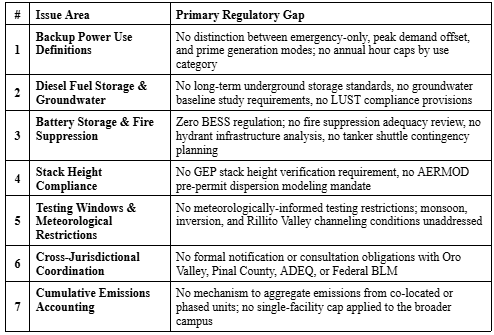
Backup Power System Use Definitions & Operating Restrictions
1.1 Background & Regulatory Gap
The current Marana ordinance and associated large-scale data center provisions contain no operative definition that distinguishes emergency-only backup power operation from peak-demand offset (PDO) or prime/continuous generation modes. This omission is material: each mode implies fundamentally different emissions profiles, annual operating hours, and regulatory treatment under EPA RICE NESHAP (40 C.F.R. Part 63, Subpart ZZZZ) and Arizona’s Title V permitting framework administered by ADEQ.
EPA’s RICE NESHAP “emergency stationary RICE” classification — which carries significantly relaxed emission standards and is exempt from certain operating hour limits under normal circumstances — applies only to engines used in a bona fide emergency context. Permitting an engine as “emergency” while allowing PDO or prime generation use without disclosure constitutes a violation of federal classification criteria and undermines the integrity of ADEQ’s Title V or Class I permitting review.
1.2 Recommended Ordinance Provisions
The Town of Marana should amend its data center land use provisions to require the following, as conditions of any development permit or major use permit for facilities with backup generation capacity exceeding 1 MW aggregate.
1.2.1 Defined Use Categories
All backup generation units shall be classified in the permit application under one or more of the following mutually exclusive categories:
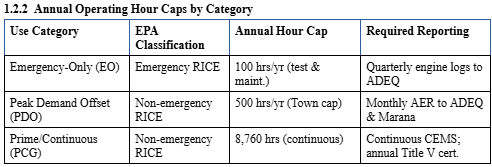
Emergency-Only (EO): Operation limited to grid outages, emergencies, and required testing. Subject to RICE NESHAP 100-hour annual limit for maintenance and testing.
Peak Demand Offset (PDO): Operation during high-grid-demand periods or when utility rates exceed defined thresholds. Subject to non-emergency RICE standards and full Title V accounting.
Prime/Continuous Generation (PCG): Operation as a primary or co-primary power source, regardless of grid availability. Subject to maximum emission control technology requirements.
1.2.2 Annual Operating Hour Caps by Category
1.2.3 Anti-Reclassification Provision
Permits shall expressly prohibit reclassification of a unit from Emergency-Only to PDO or PCG without a new major use permit application, a revised air quality permit from ADEQ, and a public hearing before the Marana Town Council. Any unit found operating outside its permitted classification shall be subject to permit revocation and referral to ADEQ for enforcement action under A.R.S. § 49-467.
1.3 Required Studies
Baseline Emissions Inventory: Applicant shall submit a facility-wide emissions inventory for all backup power units, disaggregated by use category, prior to permit issuance. Inventory must include NOx, SO2, PM2.5, PM10, CO, CO2, and HAPs.
Operational Scenario Analysis: A probabilistic analysis of PDO use frequency and duration based on Trico/TEP grid stress event data for the prior five years, to validate annual hour cap adequacy.
BACT Analysis for Non-Emergency Units: Any unit classified as PDO or PCG shall undergo a Best Available Control Technology analysis prior to permit issuance, subject to ADEQ review.
Diesel Fuel Long-Term Storage, Groundwater Protection & LUST Compliance
2.1 Background & Regulatory Gap
A 750 MW hyperscale data center with comprehensive N+1 or 2N backup power redundancy would require on-site diesel fuel storage ranging from 500,000 to 2,000,000+ gallons, depending on runtime design standards. At this scale, on-site fuel storage would be among the most significant underground storage tank (UST) or above-ground storage tank (AST) installations in Pima County. Despite this, the current Marana ordinance contains no provisions addressing fuel storage design standards, secondary containment requirements, groundwater monitoring or leak monitoring obligations, or coordination with ADEQ’s Underground Storage Tank program.
The Luckett Road site is in close proximity to recharge zones associated with the Tucson Active Management Area (Tucson AMA). ADWR and ADEQ regulatory jurisdiction over groundwater in this area is substantial. Any fuel release — even a minor one — has the potential to impact drinking water supply wells in the Marana service area and Central Arizona Project recharge facilities.
2.2 Recommended Ordinance Provisions
2.2.1 Storage Tank Design Standards
All diesel fuel storage tanks with individual capacity exceeding 1,100 gallons shall be double-walled ASTs with continuous interstitial monitoring, or double-walled USTs with cathodic protection and interstitial monitoring.
ASTs with aggregate capacity exceeding 10,000 gallons shall be sited within a fully lined secondary containment structure sized to hold 110% of the largest single tank volume.
Tank design shall meet or exceed NFPA 30 and EPA 40 C.F.R. Part 280 standards. Submittal of a PE-stamped tank design, including secondary containment calculations, shall be required with the permit application.
2.2.2 Groundwater Baseline & Monitoring
Applicant shall submit a Phase I and Phase II Environmental Site Assessment (ESA) per ASTM E1527-21 and E1903-19 prior to any grading permit issuance.
A minimum of three (3) groundwater monitoring wells shall be installed upgradient and downgradient of the primary fuel storage area. Baseline sampling shall be completed for at least four (4) consecutive quarters prior to facility operations.
Monitoring wells shall be sampled semi-annually during operation, and results shall be submitted to the ADEQ UST Section and Marana Town Engineering. Parameters shall include BTEX compounds, TPH-diesel, MTBE, and EPA Method 8270 semi-volatiles.
2.2.3 Leaking Underground Storage Tank (LUST) Compliance
Applicant shall register all USTs with ADEQ prior to installation and maintain current operator certification in accordance with A.A.C. R18-12-301 et seq.
A Spill Prevention, Control, and Countermeasure (SPCC) Plan meeting 40 C.F.R. Part 112 shall be prepared by a licensed PE and submitted to EPA Region 9 and ADEQ prior to permit issuance.
An emergency fuel release notification protocol shall be incorporated into the facility’s Emergency Response Plan, with immediate notification to local Fire, ADEQ Emergency Response, and ADWR within one hour of any confirmed release.
2.3 Required Studies & Analysis
Hydrogeological Assessment: An independent hydrogeological assessment shall be required to map the depth to the water table, groundwater flow direction, and proximity to municipal and private supply wells within a 2-mile radius.
Fate & Transport Modeling: For any facility storing more than 500,000 gallons of diesel, a groundwater fate and transport model shall be prepared demonstrating that a maximum credible release scenario does not reach any drinking water supply well within its cleanup timeframe.
Cumulative Tank Risk Analysis: If multiple facilities are proposed on adjacent parcels, Marana should engage with ADEQ to require a cumulative risk assessment treating the combined storage footprint as a single regulated facility.
Battery Energy Storage Systems, Fire Suppression Infrastructure & Road Impacts
3.1 Background & Regulatory Gap
Battery Energy Storage Systems (BESS) are increasingly deployed at hyperscale data centers as an alternative or supplement to diesel generators or gas turbine power sources for short-duration bridging power, demand response, and UPS applications. Large lithium-ion BESS installations present a category of risk — particularly thermal runaway and cascading cell failure — that is substantially different from and additive to the risks posed by diesel/natural gas generation. Critically, the current Marana ordinance contains zero provisions specifically addressing BESS installations at data centers.
Of equal concern is the fire suppression infrastructure implication. A BESS thermal runaway event at this scale may require sustained suppression water volumes that far exceed those anticipated by standard fire flow calculations. The Luckett Road area currently lacks the hydrant infrastructure density and water main sizing to support simultaneous attack and cooling operations of the magnitude required by a large BESS fire. This creates a foreseeable scenario in which local fire suppression infrastructure would be required to potentially operate tanker shuttle operations for extended periods — a significant stress on road infrastructure, mutual aid resources, and public safety.
3.2 Recommended Ordinance Provisions
3.2.1 BESS Permitting Requirements
Any BESS installation with an aggregate capacity exceeding 600 kWh (the NFPA 855 large installation threshold) shall require a separate Special Use Permit from Marana, independent of and in addition to any data center development permit.
The Special Use Permit application shall include: battery chemistry disclosure, thermal management system design, BMS (Battery Management System) failure mode analysis, and a site-specific Thermal Runaway Hazard Analysis prepared by a licensed fire protection engineer.
BESS enclosures shall conform to NFPA 855 (2023 edition), IFC Section 1207, and UL 9540A test data for the specific battery chemistry proposed. Compliance documentation shall be submitted to local fire department authorities for review prior to any building permit.
3.2.2 Fire Suppression Infrastructure
As a condition of any data center permit (BESS, natural gas, or diesel), the applicant shall commission an independent Fire Flow Study in accordance with AWWA M17 standards. The study shall evaluate the required fire flow for the facility based on the most demanding fire scenario (BESS thermal runaway, turbine fire, pipeline fire, or diesel fire, whichever is greater) and shall compare the required flow to available flow from the municipal system.
If the Fire Flow Study identifies a deficit, the applicant shall be required to fund all necessary infrastructure upgrades, including but not limited to: water main upsizing, additional hydrant installations, on-site fire water storage tanks, and dedicated fire pump systems. Upgrades shall be completed and accepted by the Town of Marana prior to any certificate of occupancy.
For BESS installations, a fixed suppression system capable of controlling a thermal runaway event and preventing the propagation of fire to adjacent modules shall be required. Water-only suppression is insufficient for lithium-ion thermal runaway; a system incorporating Class D or listed suppression agent shall be evaluated as part of the hazard analysis.
3.2.3 Tanker Shuttle Contingency & Road Infrastructure
If a fire flow deficit cannot be remediated through infrastructure upgrades within a reasonable timeframe, the applicant shall be required to maintain on-site dedicated water storage of not less than 500,000 gallons in a listed fire suppression reserve tank, with fill connections accessible to Fire Department tankers.
Any permit contingent on tanker shuttle operations shall require a Tanker Shuttle Operations Plan, reviewed and approved by local fire authorities, that identifies: staging areas, ingress/egress routes, minimum tanker specifications, and mutual aid agreements with relevant fire suppression services.
The applicant shall fund an independent road infrastructure assessment of all tanker shuttle routes, evaluating pavement load ratings, bridge capacity (if present) at any point along the defined routes, turning radii, and intersection geometry for Class 8 tanker operations. Any deficiencies identified shall be remediated at the applicant’s cost prior to permit issuance.

3.3 Required Studies
Quantitative Risk Assessment (QRA): A formal QRA for BESS installations exceeding 1 MWh shall be required, assessing the probability and consequences of thermal-runaway scenarios using fault-tree and event-tree analyses.
Fire Flow & Infrastructure Adequacy Study: Independent study as described in 3.2.2, submitted with the development application.
Road Load Rating Analysis: As described in 3.2.3, covering all identified tanker routes.
Mutual Aid Gap Analysis: A formal analysis of whether existing mutual aid agreements provide adequate tanker and suppression resources within a response time compatible with fire scenario timelines.
Stack Height Compliance & AERMOD Pre-Permit Modeling
4.1 Background & Regulatory Gap
Good Engineering Practice (GEP) stack height — as defined in 40 C.F.R. § 51.100(ii) and EPA’s “Good Engineering Practice Stack Height” guidance — establishes the minimum stack height required to ensure that building wake effects do not result in excessive ground-level concentrations of pollutants. For data center facilities, where exhaust stacks may be located adjacent to large server hall structures and cooling towers, downwash effects are a significant concern. The current Marana ordinance contains no GEP stack height requirements and does not mandate pre-permit AERMOD dispersion modeling.
The Pinal County PM2.5 nonattainment area boundary runs roughly 40 miles from the Luckett Road site, which, based on first-principles modeling, suggests conditions capable of sending plumes into this area, given potential design considerations for on-site power solutions. Additionally, the site’s position in the Rillito River valley creates channeling effects that can carry stack emissions toward the nonattainment boundary during certain meteorological conditions. Any ground-level concentration enhancement caused by inadequate stack height has the potential to trigger NAAQS exceedance concerns in an already-sensitive airshed.
4.2 Recommended Ordinance Provisions
4.2.1 GEP Stack Height Requirement
All stationary combustion units at data center facilities with rated capacity exceeding 500 kW per unit shall be equipped with exhaust stacks meeting or exceeding GEP stack height as calculated per 40 C.F.R. § 51.100(ii) formula: H_s = H + 1.5L, where H is the height of nearby structures, and L is the lesser dimension of the adjacent structure.
GEP calculations shall be performed by a licensed air quality engineer and submitted with the permit application. ADEQ shall review GEP calculations as part of the Class I or Title V permit review process. Marana shall not issue a building permit for any exhaust stack unless GEP compliance is documented and ADEQ review outcomes are presented.
In cases where GEP height cannot be achieved due to FAA obstruction clearance restrictions (given proximity to Marana Regional Airport), the applicant shall be required to demonstrate equivalent dispersion performance through AERMOD modeling with enhanced stack velocity design.
4.2.2 Pre-Permit AERMOD Dispersion Modeling
A Class I Air Quality Impact Analysis (AQIA) using EPA-approved AERMOD (version current at time of application) shall be required for any data center facility exceeding 2 MW aggregate backup generation capacity. Modeling shall use site-specific meteorological data from NWS Tucson (KTUS) processed through AERMET, and shall incorporate terrain and building downwash inputs.
Modeling shall evaluate maximum ground-level concentrations for NOx (as NO2), PM2.5, PM10, SO2, and CO at the nearest sensitive receptor locations, including residences, schools, the Arizona Veterans Memorial Cemetery, and any areas within the Pinal County PM2.5 nonattainment boundary.
AERMOD results shall demonstrate compliance with all applicable NAAQS — including the 24-hour PM2.5 standard of 35 μg/m3 and the annual PM2.5 standard (currently 9 μg/m3 subject to pending D.C. Circuit review) — at all receptor locations under all modeled scenarios, including maximum facility operation.

4.3 Required Studies
GEP Stack Height Calculations: PE-stamped, submitted with permit application.
AERMOD Impact Analysis: Full modeling report including all inputs, meteorological data processing documentation, receptor grid specifications, and tabulated results.
Building Downwash Analysis: BPIP-PRIME processing for all structures within the facility footprint, submitted as part of the AERMOD input package.
Testing Windows & Operating Restrictions — Meteorological Conditions
5.1 Background & Regulatory Gap
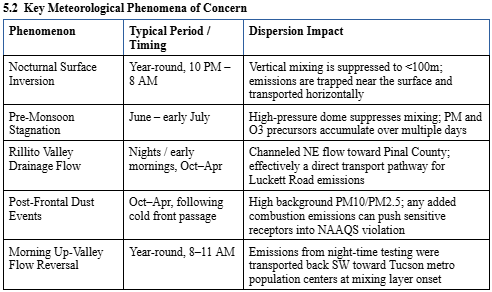
The Tucson-Marana airshed is subject to meteorological conditions that create periods of dramatically reduced atmospheric mixing and enhanced pollutant transport toward populated areas. These include nocturnal surface inversions that form in the Rillito Valley, monsoon-season stagnation events prior to convective initiation, and topographically-driven drainage flows that channel emissions along the river corridor toward the Pinal County nonattainment boundary. The current ordinance contains no provisions restricting generator testing or non-emergency operation during these adverse conditions, only the standard day/night cycle.
ADEQ’s existing air quality rules contain limited provisions for meteorologically-restricted operations, but these are oriented toward episodic Area Source rules (e.g., wood burning) rather than stationary combustion sources. A gap, therefore, exists in which generator testing — which represents the largest discretionary emissions event from these facilities — is essentially unrestricted by day or atmospheric conditions.
5.2 Key Meteorological Phenomena of Concern
5.3 Recommended Ordinance Provisions
5.3.1 Prohibited Testing Windows
Routine load testing and maintenance testing of backup generators shall be prohibited during the following windows, absent a documented operational emergency:
Daily: 5:00 PM to 8:00 AM local time (nocturnal inversion hours) - already in place in the ordinance
Seasonal: June 1 through July 14 of each year (pre-monsoon stagnation period)
ADEQ Air Quality Action Days and Ozone Watch/Warning Days for the Tucson-Marana area
Any period when NWS Tucson issues a Dense Smoke Advisory or when 24-hr PM2.5 at the nearest ADEQ monitor exceeds 25 μg/m³
5.3.2 Preferred Testing Windows
Permitted testing windows shall be defined as: Weekdays, 9:00 AM to 3:00 PM local time, excluding the June 1–July 14 window. This period aligns with maximum mixing-layer development, prevailing winds, and minimum receptor exposure.
Applicant shall provide advance notification to Marana, ADEQ, and Pinal County Air Quality Control District no less than 48 hours prior to any planned load test, including planned duration and units to be tested.
5.3.3 Meteorological Monitoring Requirement
Any facility with aggregate backup generation capacity exceeding 5 MW shall install and maintain an on-site meteorological monitoring station that meets ADEQ specifications, including wind speed, wind direction, temperature, mixing height (via sodar or equivalent), and relative humidity. Real-time data shall be transmitted to ADEQ and made publicly available.
5.4 Required Studies
Site-Specific Meteorological Analysis: A one-year meteorological study using on-site monitoring data (or NWS KTUS processed data) characterizing inversion frequency, mixing heights, and drainage flow events. Required prior to permit issuance for facilities exceeding 2 MW aggregate.
Worst-Case Dispersion Analysis: AERMOD modeling run for the meteorological conditions identified as worst-case for each key phenomenon in the table above, demonstrating NAAQS compliance under worst-case conditions.
Cross-Jurisdictional Coordination — Oro Valley, Pinal County, ADEQ & DOI
6.1 Background & Regulatory Gap
The Luckett Road site’s geographic position creates a multi-jurisdictional impact footprint that has received no attention in the current Marana ordinance framework. Plume modeling under the meteorological conditions described in Section 5 demonstrates potential transport pathways reaching: (1) the Town of Oro Valley, particularly toward the Rancho Vistoso area; (2) the Pinal County PM2.5 nonattainment boundary; and (3) Ironwood Forest National Monument, a federally managed sensitive area administered by the Bureau of Land Management under the Department of the Interior. None of these entities has been formally identified as a receiving jurisdiction, consultation partner, or notification recipient in any submitted application materials publicly available.
6.2 Coordination Requirements by Agency
6.2.1 Town of Oro Valley
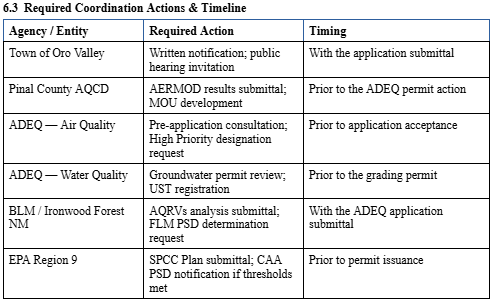
Formal written notification to the Town of Oro Valley Planning and Zoning Director shall be required as part of any Marana Type II Major Use Permit application for a data center facility at Luckett Road or a similar area, where modeling would indicate plume incursion on Oro Valley township land. Notification shall include AERMOD modeling results and worst-case receptor analysis for Oro Valley receptor locations.
Marana shall formally invite Oro Valley to participate as an interested party in any public hearing on the permit application, with at least 30 days’ advance notice.
6.2.2 Pinal County Air Quality Control District
Given the proximity of the Pinal County PM2.5 nonattainment boundary, the applicant shall be required to submit AERMOD modeling results demonstrating no modeled contribution to nonattainment at the boundary under any operational scenario. Results shall be submitted directly to Pinal County AQCD for review and comment prior to ADEQ permit action.
Marana shall coordinate with Pinal County to draft a Memorandum of Understanding (MOU) that defines ongoing notification obligations, including ADEQ Action Day communications and incident reporting protocols.
6.2.3 Arizona Department of Environmental Quality (ADEQ)
ADEQ coordination is required under existing state law for any Title V major source permit. Marana shall, as an additional ordinance requirement, condition its local permit on the prior receipt of all required ADEQ permits, including Air Quality Control Permit, any required groundwater protection permit, and any applicable solid or hazardous waste registrations.
Marana shall request that ADEQ designate any Luckett Road data center facility as a High Priority Facility for inspection purposes, given the scale of emissions and proximity to the Pinal County nonattainment area. This should also apply to any future facilities of similar size and emission potential.
Marana shall formally request that ADEQ initiate a pre-application consultation process under A.R.S. § 49-426(C) before accepting any Title V application from a Luckett Road data center operator or similar future operator, to ensure all state-level concerns are identified and addressed early.
6.2.4 Department of the Interior — Bureau of Land Management (Ironwood Forest NM)
Ironwood Forest National Monument lies within the modeled potential plume-transport corridor under observed meteorological conditions in the area. Under 40 C.F.R. Part 51, Subpart P (Prevention of Significant Deterioration), BLM has standing as a Federal Land Manager (FLM) to review permit applications that may affect air quality-related values (AQRVs) in federal lands, including visibility and sensitive vegetation.
The applicant shall be required to submit a Class I PSD AQRVs analysis to the BLM Arizona State Office and Ironwood Forest NM staff, evaluating visibility impairment, deposition, and ozone impacts on the Monument under maximum facility operating scenarios, if any, and indicating plume incursion into the area using reasonably modeled meteorological scenarios.
Marana shall formally notify BLM’s Arizona State Office of the permit application and request a written determination of whether federal PSD Class I consultation is triggered. This determination shall be obtained prior to Marana’s own permit action.
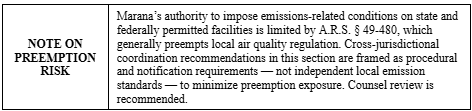
6.3 Required Coordination Actions & Timeline
Cumulative Emissions Accounting & Campus-Level Permitting
7.1 Background & Regulatory Gap
The Luckett Road complex is expected to involve multiple co-located or sequentially-developed data center structures on adjacent parcels, potentially developed by different legal entities or under different ownership structures. A critical regulatory vulnerability in the current framework is the absence of any requirement to aggregate emissions across the entire campus footprint for purposes of determining permit thresholds, NAAQS compliance, and PSD applicability. Without aggregation requirements, individual facilities could each remain below major source thresholds while their combined emissions constitute a major source.
EPA’s source aggregation doctrine (”single source” rules under 40 C.F.R. § 52.21) and ADEQ’s implementation of PSD rules address this in theory, but the burden of making the aggregation argument has historically fallen on regulators or interveners rather than being proactively required by local permit conditions. Marana has an opportunity to close this gap locally.
7.2 Recommended Ordinance Provisions
Any data center development permit application within one mile of an existing or previously permitted data center facility shall include an aggregated emissions analysis treating all facilities within that radius as a single source for purposes of determining PSD and Title V major source applicability.
Campus-level emissions caps shall be established as a condition of each individual facility permit, such that the sum of permitted emissions across all co-located facilities does not exceed the campus cap without a new public hearing and permit modification.
Annual emissions reports from all campus facilities shall be cross-referenced by ADEQ and Marana to verify that campus-level caps are not being approached without proactive permit action.
Marana shall require disclosure in any data center permit application of any common ownership, operational, or contractual relationships between the applicant and operators of other data center facilities within a one-mile radius.
7.3 Required Studies
Campus-Level Baseline Emissions Inventory: Prior to any subsequent facility permit approval on the Luckett Road complex, a cumulative inventory of all approved and proposed sources shall be submitted.
Aggregated AERMOD Modeling: Full campus-scale dispersion modeling treating all sources as a single facility, submitted with each individual permit application after the first.
Sonoran Think Tank — Marana Data Center Policy Initiative
This document is prepared for use in regulatory advocacy, support for ordinance amendment drafting, and encouragement of interagency coordination.
Not intended as legal advice. All regulatory references should be verified against current federal, state, and local codes.
This was so in depth and honestly a lot for me to unpack, but I learned so much. Most regular citizens don’t have any idea of what is going on behind the scenes and how these data centers operate. It’s frightening how much of this information is unknown. We definitely need AZ to place a state wide moratorium on these data centers. Our elected leaders have to stop choosing big corporations and big money over what the majority of the residents want. Thank you for providing this info. for us to read and educate ourselves. Also, thank you for your community involvement and preparing this in depth regulatory recommendation, along with getting involved in these meetings and speaking publicly. This is exactly what needs to be done to bring awareness of these AI data centers.