
When Common Zoning Tools Fail At Scale
Why regulators need to shift their thinking on historical tools for managing industrial projects.

When a hyperscale data center is proposed, the environmental impact submission almost always includes a section on landscaping. Renderings show tree-lined buffers, native plantings, and shaded walkways. The implication, sometimes stated and sometimes left to the reader, is that this vegetation will help offset negative impacts such as the urban heat island effect created by the facility or noise.
This claim deserves a closer look, not because vegetation is bad; it is genuinely valuable for stormwater, habitat, albedo, and pedestrian comfort, but because the specific claim that trees can mitigate the thermal or noise output of a hyperscale computing facility is a thermodynamic question, and that question has a clear answer.
The answer is no. Not “no, but with effort,” and not “no, unless we plant more.” It is a categorical no, by roughly a factor of one hundred to one thousand, depending on how you draw the boundary.
Vegetation buffers have a long and legitimate history in zoning practice as both thermal and acoustic mitigation. Transition buffers between residential and commercial uses, highway noise berms with planted screens, and parking lot shade tree requirements all reflect a real engineering basis: a 50-foot densely planted buffer attenuates roughly 5 to 10 decibels of roadway noise in the frequency range where traffic noise concentrates, and a mature parking lot canopy reduces near-surface air temperatures by several degrees Celsius. These tools work because the source intensities they were calibrated against sit in the same dimensional category as what vegetation can actually deliver, both in heat flux (a few hundred watts per square meter of solar-driven parking lot heat against vegetation's evapotranspiration capacity) and in acoustic frequency content (1,000 to 8,000 hertz traffic noise against the high-frequency scattering canopy structures can produce).
The hyperscale data center case breaks both simultaneously. A hyperscale cooling tower array rejects 10,000 to 50,000 watts per square meter of continuous waste heat, one to three orders of magnitude above the heat flux densities against which buffer landscaping was developed. The acoustic source content is even further out of range: cooling tower fan blade pass tones at 100 to 500 hertz, generator exhaust tones at 30 to 120 hertz, and transformer hum at 120 hertz are all in the low frequency band where vegetation attenuation approaches zero, since the sound wavelengths involved are larger than any element of the canopy doing the scattering.
Applying the same buffer tool to a multi-hundred-megawatt industrial thermal source emitting low-frequency tonal noise around the clock is a category error rather than a margin of error: the mechanisms that work at the zoning scale do not scale linearly into the industrial process scale, and in the acoustic case, they do not transfer into the relevant frequency band at all.
The Heat Load Is Larger Than People Realize
A data center’s “IT load” is the electricity consumed by computing equipment, the servers, storage, and networking gear that do the actual work. Almost every watt of that electricity is converted to heat, and that heat has to be rejected somewhere. The total heat a facility releases into the environment also includes the power consumed by cooling and other support systems, as captured in a metric called Power Usage Effectiveness, or PUE.
For a modern hyperscale facility, total waste heat is typically 1.2 to 1.5 times the IT load. That gives the following numbers:
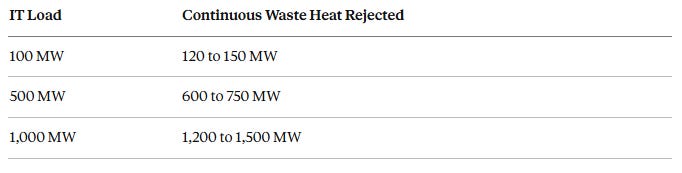
These are not peak values. Hyperscale data centers operate around the clock at high utilization, so this heat is rejected continuously, day and night, summer and winter. A 500-megawatt IT load campus is putting roughly the thermal output of a small city’s electricity demand into a roughly two-hundred-acre footprint every hour, year-round.
What Vegetation Does
Trees and vegetation cool their surroundings primarily through evapotranspiration. Water moves from the soil to the roots, up the trunk, and out through pores in the leaves called stomata, where it evaporates into the air. That phase change from liquid to vapor absorbs heat, about 2,450 kilojoules per kilogram of water transpired. Trees also shade surfaces and reflect more sunlight than asphalt, which helps with surface temperatures.
The peer-reviewed literature on urban tree cooling is solid and well-established. Under favorable conditions, meaning a temperate climate, well-watered soil, a mature canopy, and moderate vapor pressure deficit, a mature urban tree transpires roughly 100 to 200 liters of water per day, producing a daytime cooling effect equivalent to 0.5 to 1.0 kilowatts. A dense mature canopy can deliver 50 to 200 kilowatts of peak daytime cooling per acre, or roughly 20 to 80 kilowatts averaged over a full 24-hour period.
Those are real numbers, and they are not trivial at the pedestrian scale. A shaded street is genuinely cooler than an unshaded one. A neighborhood park reduces local surface temperatures by several degrees Celsius. None of this is in dispute.
The Scale Problem
The scale problem becomes clear the moment you put facility waste heat and vegetation cooling capacity in the same units, megawatts.
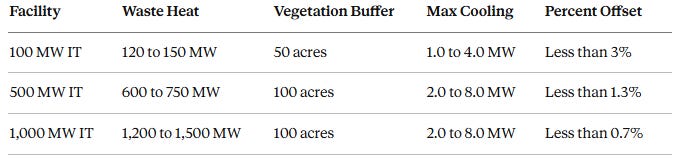
These percentages already use favorable temperate climate cooling values, applied generously to maximize the credit given to the vegetation argument. Even with that thumb on the scale, no plausible buffer configuration offsets more than about 3 percent of the heat load.
To offset even 10 percent of a 500 megawatt facility’s waste heat under favorable temperate conditions would require somewhere between 750 and 3,750 acres of dense mature tree canopy. That is roughly 1.2 to 5.9 square miles of continuous forest. No data center proposal, anywhere, includes anything remotely approaching this scale of vegetation.
The deeper issue is dimensional. Vegetation is a square-meter-scale thermal regulator. A hyperscale data center is a megawatt-scale thermal generator. Heat flux density at a typical cooling tower runs 10,000 to 50,000 watts per square meter. The heat flux density that vegetation can absorb under peak solar conditions is roughly 50 to 200 watts per square meter of leaf area. The ratio of source intensity to sink capacity exceeds 100:1 at the point where heat is being rejected. No quantity of trees that can fit on or near the campus can close that gap.
The Sonoran Desert Makes a Weak Case Worse
Everything above uses temperate climate cooling values. The Marana and Tucson contexts are harsher in three independent ways, and each further reduces vegetation’s already negligible thermal contribution.
Photosynthetic pathway mismatch. Cacti, agaves, and the other iconic Sonoran Desert plants use a metabolic pathway called Crassulacean Acid Metabolism (CAM), in which stomata open only at night. During the day, when solar radiation would in principle drive evapotranspiration, CAM plant stomata are closed. Their daytime cooling contribution is essentially zero. Saguaros, prickly pear, and agaves are wonderful plants for many reasons, but as daytime thermal mitigation, they have no physical effect.
Vapor pressure deficit and stomatal closure. Vapor pressure deficit, or VPD, measures how dry the air is relative to how aggressively it pulls moisture from any wet surface. Tucson and Marana experience some of the highest sustained VPD values in North America. In May and June, with VPD often above 4 kilopascals, even C3 plants like palo verde and mesquite close their stomata to avoid desiccation, reducing transpiration by 60 to 85 percent compared to temperate reference values. The peak data center thermal stress period, late spring and pre-monsoon summer, coincides exactly with the period of maximum stomatal closure. The cooling mechanism fails precisely when it is most needed.
The irrigation trap. The only way to keep transpiration going through the dry season is to irrigate non native shade trees with 75 to 150 liters per tree per day. A 10-acre irrigated tree buffer at 100 trees per acre, therefore, consumes 750,000 to 1,500,000 liters of water per day during the high-demand months. That water has to come from the same Active Management Area aquifer that the data center itself is drawing from. The result is an irrigation regime that imposes a substantial consumptive water demand on a stressed groundwater basin, in exchange for a thermal offset that does not exceed about 0.4 percent of the facility's waste heat.
When the desert-specific reductions are applied to the mitigation gap table, the numbers shift from “less than 3 percent” to “less than 0.2 percent” for a 500-megawatt facility with a 10-acre native buffer. The gap does not narrow; it widens.
Why the Argument Persists
If the thermodynamics are this clear, why does the vegetation argument keep showing up in environmental impact submissions and council testimonies? Several factors sustain it, and recognizing them is useful for reviewers.
Visual persuasion does most of the work. Renderings of tree-lined buffers communicate environmental stewardship effectively to non-technical audiences in a way that a heat balance spreadsheet cannot. The image substitutes for the analysis.
Genuine but narrow co-benefits provide cover. Vegetation really does help with stormwater, habitat, surface albedo, and pedestrian comfort. These benefits are real; they are simply on the wrong dimensional scale to address the primary thermal load. Presenting them without that scale framing leaves the reader to assume they add up to mitigation when they do not.
Cost asymmetry favors landscaping. Meaningful thermal mitigation, advanced cooling technology, waste-heat recovery, district-heating integration, and strategic siting are expensive and operationally constraining. Landscaping is cheap and imposes no operational constraints. Developers rationally prefer commitments that satisfy regulatory requirements without affecting operations.
Reviewer knowledge gaps complete the loop. Planning commissions and town councils rarely include members with the engineering background needed to quantitatively evaluate megawatt-scale heat flux claims. Without staff or retained expert support running the mass balance check, vegetation proposals are accepted at face value. Once accepted in one jurisdiction, they become precedent for the next.
The category error here is the same one you would make if you proposed that a garden hose can extinguish an industrial fire because water is an effective fire suppressant.
What Adequate Mitigation Actually Looks Like
For completeness, the technical analysis identifies the categories of intervention that operate at a scale relevant to hyperscale heat rejection. These are not optional extras to be added on top of landscaping. They are the actual mitigation universe.
Siting and orientation. Prevailing wind analysis to keep cooling tower plumes away from sensitive receptors. Setbacks calculated from receptor modeling rather than generic zoning buffers. Avoid sites with persistent inversions or low wind corridors. Clustering on already disturbed industrial land rather than greenfield conversion.
Cooling system design. Hybrid dry and wet cooling, advanced adiabatic systems, direct liquid cooling, and exhaust stack height optimization all change either the magnitude or spatial distribution of heat rejection in ways that affect ground-level receptors.
Waste heat recovery. Data center waste heat at 30 to 60 degrees Celsius is suitable for low-temperature district heating, certain industrial processes, greenhouse agriculture, aquaculture, and absorption cooling. Several European operators have demonstrated commercially viable implementations. This is the one category that converts an environmental liability into a usable resource.
Performance-based monitoring. Pre-construction thermal baseline monitoring at receptor locations, post-construction continuous ambient temperature monitoring with public reporting, and mitigation standards keyed to demonstrated receptor temperature compliance rather than input commitments like “plant 500 trees” that cannot be verified against outcomes.
A reasonable analytical standard for any proposed mitigation measure is that it must demonstrate an offset of at least 10 percent of facility waste heat to qualify for credit in environmental review. A 500-megawatt facility would therefore require mitigation demonstrating 60 to 75 megawatts of continuous thermal offset. No landscaping program reaches that threshold. Establishing this standard in local ordinance language would structurally redirect applicants toward engineered thermal mitigation rather than cosmetic vegetation commitments.
What Questions Should Be Asked
For planning commissioners, council members, and civic advocates evaluating these proposals, the analytical question is simple and quantitative.
Total facility waste-heat rejection should be stated in megawatts at the rated IT load and the design-basis operational load, with PUE assumptions documented. Proposed mitigation cooling capacity should be stated in megawatts equivalent, using site-appropriate values rather than national averages, with a 24-hour average correction applied. The mitigation percentage should be stated explicitly. The residual unmitigated thermal load should be identified, along with the predicted receptor location temperature impact of that residual load.
If a vegetation commitment cannot survive that arithmetic, and no plausible vegetation commitment can at hyperscale, it should be characterized as landscaping. Landscaping has value. Mitigation has a definition. They are not interchangeable.
The full technical analysis, including the species-specific desert physiology addendum, the seasonal mismatch tables, and the thermodynamic derivations, is available as a public resource for any jurisdiction or reviewer engaged with hyperscale data center proposals.
This post summarizes a Sonoran Think Tank technical analysis released here:
Vegetation Analysis
The full report includes complete citations, methodology notes, and the desert-specific addendum. STT research is freely available to planning bodies, civic advocates, and journalists.